If your period shows up whenever it feels like it — sometimes 25 days, sometimes 40, sometimes somewhere in between — you’ve probably been told that an ovulation calculator won’t work for you. That it’s only designed for women with perfect, textbook 28-day cycles.
That’s not entirely true. While a standard ovulation calculator does assume regularity, there are practical, science-backed methods to calculate ovulation with irregular periods — and they work. You just need a slightly different approach.
This guide is for every woman who has Googled “ovulation calculator irregular periods” at 2 AM, feeling frustrated and unsure. We see you — and we’re here to help.

What Counts as an “Irregular” Period?
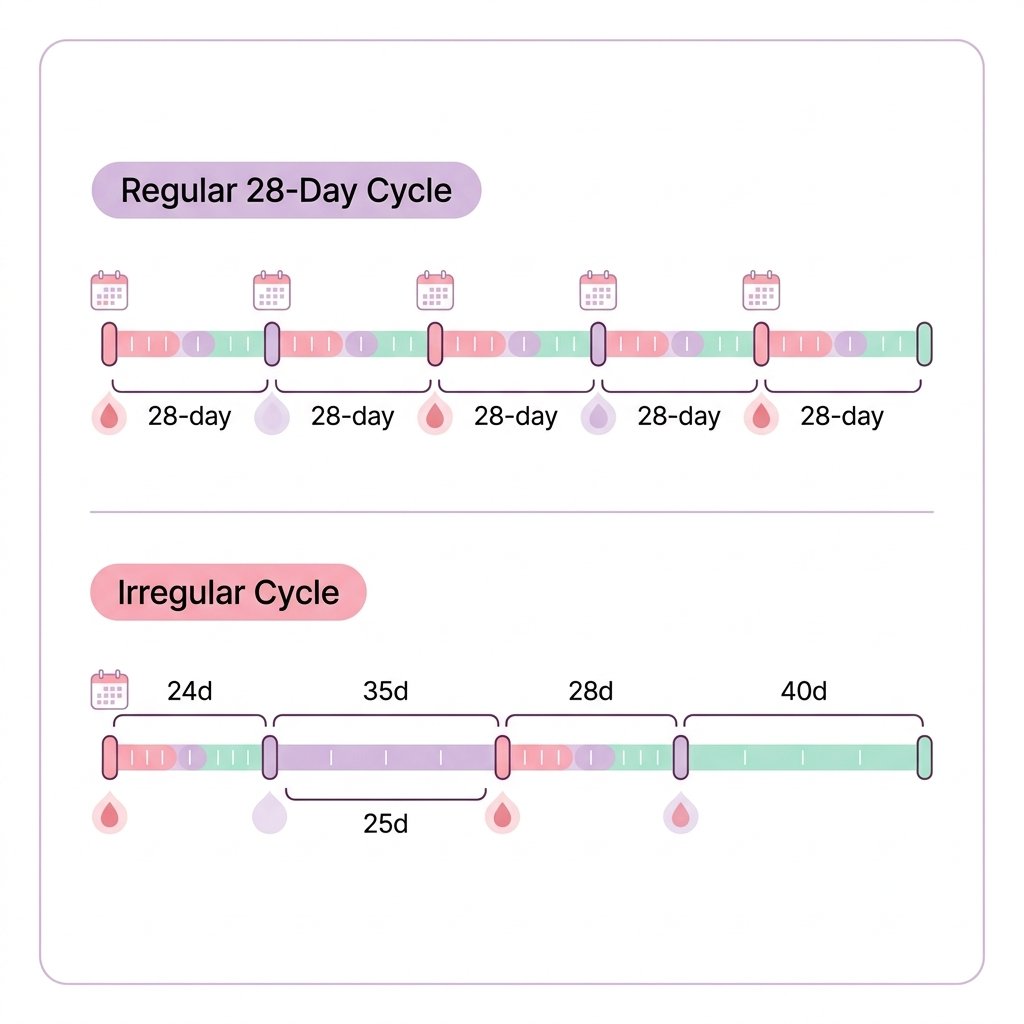
Before we dive into solutions, let’s define what irregular actually means. A menstrual cycle is considered irregular if:
- Your cycle length varies by more than 7–9 days from month to month
- Your cycles are consistently shorter than 21 days or longer than 35 days
- You occasionally skip periods entirely (without pregnancy)
- Your period length or flow changes significantly each month
A cycle that’s consistently 33 days isn’t irregular — it’s just not 28 days. That’s perfectly normal. Irregularity is about unpredictability, not length.
Why Are Your Periods Irregular?
Understanding the why can help you choose the right tracking method. Common causes include:
- PCOS (Polycystic Ovary Syndrome) — the most common hormonal disorder in women of reproductive age. It disrupts ovulation, causing missed or delayed periods.
- Thyroid disorders — both hypothyroidism and hyperthyroidism can throw your cycle off.
- Stress and lifestyle factors — chronic stress, extreme exercise, significant weight changes, and poor sleep all affect the hypothalamus, which controls your cycle.
- Perimenopause — in the years leading up to menopause, cycles become increasingly unpredictable.
- Coming off birth control — it can take 3–6 months for your natural cycle to regulate after stopping the pill, IUD, or injection.
If you suspect PCOS or a thyroid issue, please see a healthcare provider. These conditions are very manageable once diagnosed.
Can You Still Use an Ovulation Calculator?
Yes — with a caveat. A standard ovulation calculator for irregular periods gives you an estimate rather than a guarantee. The key is to use your shortest recent cycle as the cycle length input. Here’s how:
- Look at your last 6 cycles and note the shortest one (e.g., 26 days).
- Enter that as your cycle length in the OvuDay ovulation calculator.
- The calculator will estimate your earliest possible ovulation — giving you a starting point for your fertile window.
- Then use the methods below to confirm ovulation in real time.
Think of the calculator as your first clue — not your only one.
5 Methods to Track Ovulation with Irregular Cycles
When your cycle length changes each month, the calendar method alone isn’t enough. Here are five proven methods — ranked from simplest to most precise — that work regardless of cycle regularity.
1. Cervical Mucus Monitoring (Free, Daily)
Your body produces a visible sign when ovulation is approaching. Cervical mucus changes throughout your cycle:
- After your period: Dry or minimal discharge
- Approaching ovulation: Sticky, then creamy white
- Peak fertility: Clear, stretchy, and slippery — like raw egg whites
- After ovulation: Returns to thick, sticky, or dry
When you notice that clear, stretchy mucus, ovulation is likely within 1–2 days. This method costs nothing and works even with the most irregular cycles.
2. Basal Body Temperature (BBT) Charting
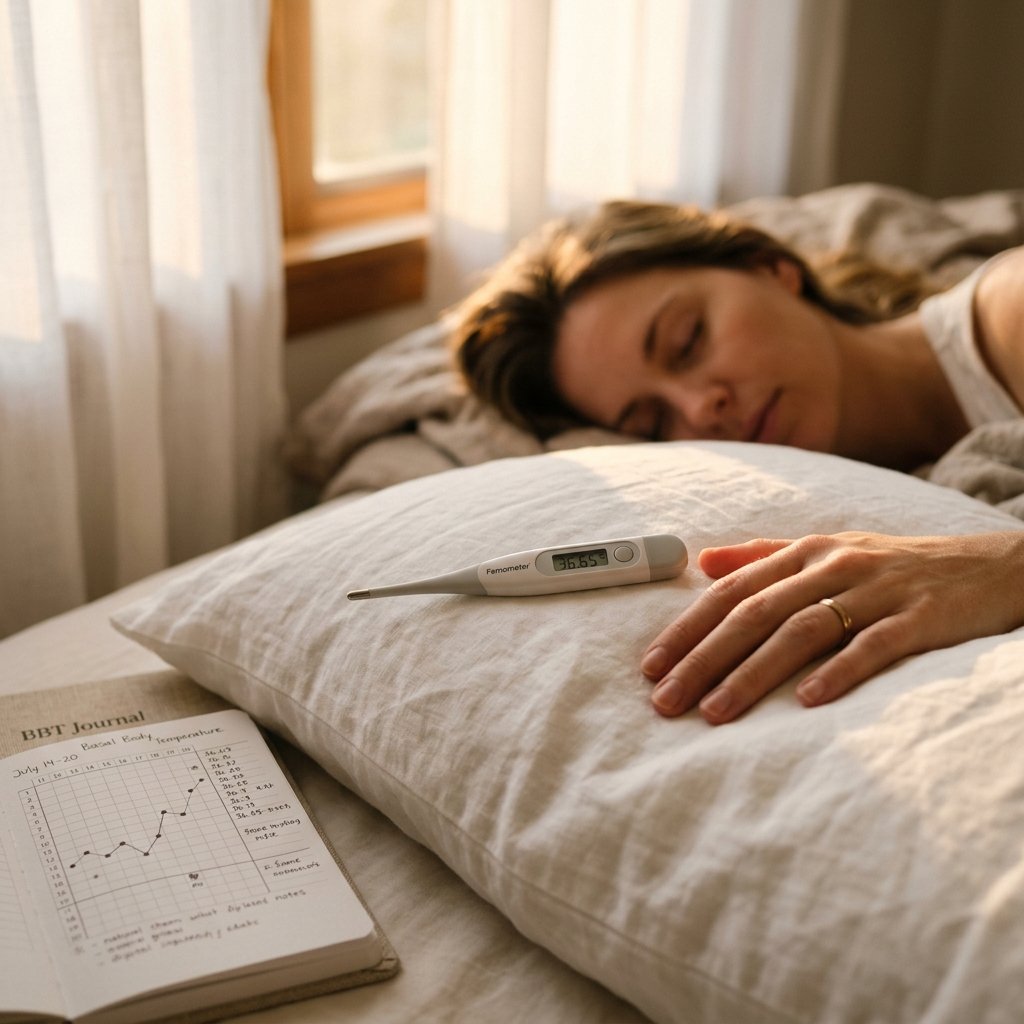
Basal body temperature is your resting temperature, taken first thing each morning before getting out of bed. Here’s why it matters:
- Before ovulation, BBT is typically between 36.1–36.4°C (97.0–97.7°F).
- After ovulation, progesterone causes a sustained rise of 0.2–0.5°C (0.4–1.0°F).
- This elevated temperature persists until your next period (or continues if you’re pregnant).
BBT charting confirms ovulation after it happens. It won’t predict the exact day in advance, but over 3–4 months, you’ll see your pattern emerge — even with irregular cycles.
Tip: Use a dedicated BBT thermometer (accurate to 0.01°C) and take it at the same time each morning.
3. OPK (Ovulation Predictor Kit) Test Strips
OPKs detect the LH (luteinising hormone) surge that happens 24–36 hours before ovulation. They’re simple urine test strips you can use at home.
For irregular cycles, the challenge is knowing when to start testing. Our recommendation:
- Start testing from day 10 of your cycle (or earlier if your shortest cycle is under 25 days).
- Test once daily until you see a faint line, then switch to twice daily to catch the surge.
- A positive OPK means ovulation is likely within the next 12–36 hours.
Budget-friendly tip: buy test strips in bulk online rather than branded kits — they use the same technology at a fraction of the price.
4. Cervical Position Checks
Your cervix changes position and texture throughout your cycle. During your fertile window:
- The cervix moves higher, becomes softer, and the opening becomes slightly more open
- After ovulation, it drops lower, firms up, and closes
This method takes practice to learn, but combined with mucus monitoring, it provides a very reliable natural fertility signal.
5. Cycle Tracking Apps + Our Calculator Combined
The most effective approach combines multiple methods. Here’s a practical workflow:
- Use the OvuDay ovulation calculator with your shortest cycle to get a baseline estimate.
- Start OPK testing a few days before that estimated date.
- Monitor cervical mucus daily for that egg-white consistency.
- Track BBT each morning to confirm ovulation occurred.
- Log everything in a simple journal or app.
After 3–4 months, you’ll have a personalised picture of your fertility pattern — even if your cycle never settles into a perfect rhythm.
PCOS and Ovulation: What You Need to Know
If you have PCOS, irregular ovulation is the core challenge. Your body may produce multiple LH surges without actually releasing an egg (called anovulatory cycles). This means:
- OPK results can show false positives — an LH surge without actual ovulation.
- BBT charting becomes your most reliable confirmation tool (no temperature rise = no ovulation that cycle).
- Cervical mucus may show fertile-type patterns multiple times per cycle.
For women with PCOS, we strongly recommend combining BBT charting with OPK testing. If BBT confirms ovulation after an LH surge, you can trust that cycle. If it doesn’t, you’ll know to keep trying.
Many women with PCOS do ovulate — just not every month. Understanding which cycles are ovulatory is the key to timing conception.
When to See a Doctor
Self-tracking is empowering, but some situations call for professional help:
- You haven’t had a period in 90 days or more
- You’ve been tracking and timing intercourse for 12 months (or 6 months if over 35) without success
- You suspect PCOS or a thyroid condition but haven’t been diagnosed
- Your cycles are consistently shorter than 21 days
- You experience severe pain, heavy bleeding, or spotting between periods
A reproductive endocrinologist can run blood tests (FSH, LH, AMH, thyroid panel) and imaging to understand exactly what’s happening. Asking for help isn’t giving up — it’s leveling up.
You’re Not Broken — Your Cycle Is Just Unique
Here’s something nobody tells you enough: only about 13% of women have a consistent 28-day cycle. The rest of us? We’re all somewhere on the spectrum of “irregular” — and that’s completely, biologically normal.
An irregular cycle doesn’t mean something is wrong with you. It doesn’t mean you can’t conceive. It just means you need to listen a little more closely to your body — and use the right tools to decode what it’s telling you.
Start with our free ovulation calculator to get your baseline, then layer in the tracking methods that feel right for you. If you’re new to all of this, our complete guide to ovulation calculators is a great first read.
Your journey is valid. Your body is capable. And understanding your cycle — even the messy, unpredictable parts — is the most empowering step you can take.
→ Calculate your estimated fertile window now — free and private
Leave a Reply