If you’ve ever found yourself staring at a calendar, counting days, and wondering “Is this the right time?” — you’re not alone. Millions of women around the world go through the same quiet calculation every month, trying to figure out when their body is most ready to conceive.
That’s exactly what an ovulation calculator is designed to help with. It takes the guesswork out of something deeply personal and gives you a clear, science-backed answer: these are your most fertile days.

What Exactly Is an Ovulation Calculator?
An ovulation calculator is a tool that estimates when you’re most likely to ovulate — the moment your ovary releases a mature egg — based on information about your menstrual cycle. You typically enter two pieces of information:
- The first day of your last menstrual period (LMP)
- Your average cycle length (most women fall between 21 and 35 days)
Some calculators, like the one here at OvuDay, also let you adjust your luteal phase length — the time between ovulation and your next period — for even more accuracy.
The result? A personalised fertile window: the roughly six days each cycle when conception is biologically possible.
Why Your Fertile Window Is Only 6 Days
This surprises many people. Out of an entire cycle — which can be 28, 30, or even 35 days — there are only about six days when pregnancy is possible. Here’s why:
- After ovulation, the egg survives for just 12 to 24 hours.
- But sperm can survive inside the reproductive tract for up to 5 days.
So the fertile window stretches from about 5 days before ovulation to 1 day after. That’s it. Miss it, and you’ll need to wait for the next cycle.
This is exactly why an ovulation calculator matters — it tells you precisely when those six days fall, based on your unique cycle.

Understanding Your Menstrual Cycle: The 4 Phases
To truly understand how an ovulation calculator works, it helps to know what’s happening inside your body throughout the month. Your cycle has four distinct phases:
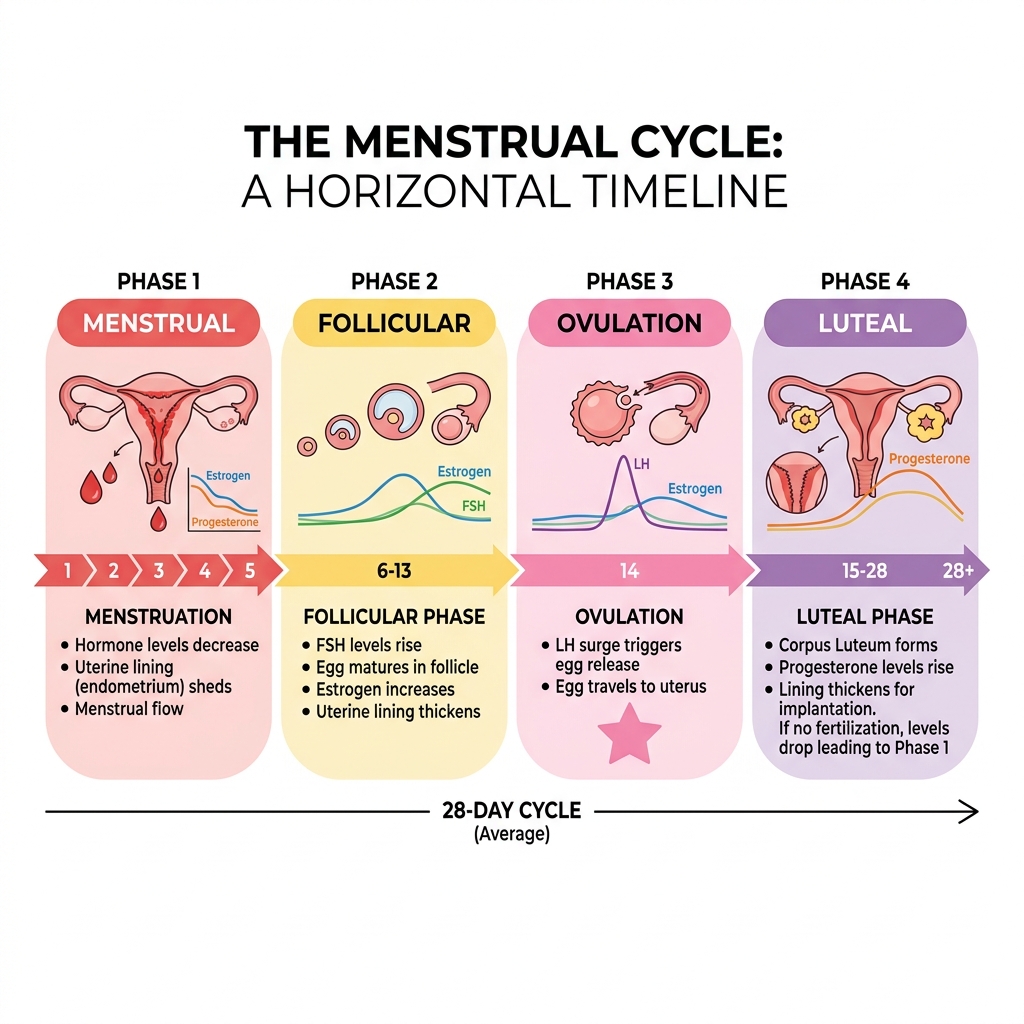
1. Menstrual Phase (Days 1–5)
This is your period. The uterine lining sheds because no fertilised egg implanted during the previous cycle. Hormone levels — especially estrogen and progesterone — are at their lowest. It’s a reset.
2. Follicular Phase (Days 1–13)
While you’re still menstruating, your brain is already preparing for the next chance. The pituitary gland releases FSH (follicle-stimulating hormone), which tells your ovaries to start developing follicles. One of these will become the dominant follicle — the one that releases the egg. Estrogen rises steadily.
3. Ovulation (Around Day 14)
A surge of LH (luteinising hormone) triggers the dominant follicle to release a mature egg into the fallopian tube. This is your peak fertility moment. The egg will survive for 12–24 hours. If sperm are present, fertilisation can occur.
4. Luteal Phase (Days 15–28)
After releasing the egg, the empty follicle transforms into the corpus luteum, which produces progesterone. This hormone thickens the uterine lining, preparing it for a potential pregnancy. If the egg isn’t fertilised, progesterone drops, and the cycle begins again with your next period.
The Formula Behind Every Ovulation Calculator
Every reliable ovulation calculator uses the same core logic — the calendar method:
Estimated Ovulation Day = First day of last period + (Cycle length − Luteal phase length)
For most women, the luteal phase is around 14 days, though it can range from 10 to 16. Here’s a worked example:
- Last period started: April 1
- Average cycle length: 28 days
- Luteal phase: 14 days
- Estimated ovulation: April 1 + (28 − 14) = April 15
- Fertile window: April 10 – April 16
That’s the power of an ovulation calculator in one simple equation. No apps to pay for, no invasive tests — just biology and basic maths.
How to Use the OvuDay Ovulation Calculator
Our free ovulation calculator is designed to be the simplest, most private tool available. Here’s how to use it:
- Enter your last period date — the first day of your most recent menstrual bleeding.
- Set your average cycle length — if you’re unsure, 28 days is a good starting point.
- Optionally adjust your luteal phase — 14 days is the default, but you can fine-tune this if you know yours is different.
- Click Calculate — and instantly see your estimated ovulation day, fertile window, and next period date.
Everything happens in your browser. We don’t store any of your data. No account, no sign-up, no tracking. Your fertility data stays yours.
Tips to Improve Your Chances
An ovulation calculator gives you the when. But here are a few things that can help with the how:
- Have intercourse every 1–2 days during your fertile window. This ensures sperm are present when the egg is released.
- Track your basal body temperature (BBT). A slight rise (0.2–0.5°C) after ovulation confirms that you did ovulate. Over a few months, this helps you spot your pattern.
- Consider LH test strips. These detect the luteinising hormone surge that happens 24–36 hours before ovulation — giving you real-time confirmation.
- Stay consistent. Track your cycle for at least 3–6 months to find your true average. Bodies aren’t clockwork, and that’s okay.
- Take care of yourself. Stress, poor sleep, and extreme dieting can all delay ovulation. Be gentle with your body during this journey.
When an Ovulation Calculator May Not Be Enough
It’s important to be honest about limitations. An ovulation calculator is an estimation tool, not a medical diagnosis. It may be less reliable if:
- Your cycles are highly irregular (varying by more than 7 days month to month).
- You have a medical condition that affects ovulation, such as PCOS (polycystic ovary syndrome) or thyroid disorders.
- You’ve recently stopped hormonal birth control — it can take a few months for your natural cycle to return.
- You’re over 35 — fertility naturally declines with age, and an ovulation calculator can’t assess egg quality.
If you’ve been trying for over 12 months (or 6 months if you’re over 35) without success, please speak with a healthcare professional. There’s no shame in asking for help — it’s one of the bravest things you can do.
A Note from Us
We built OvuDay because we believe every woman deserves access to simple, private fertility tools — without paying for expensive apps or giving away personal health data. Whether you’re just starting to think about trying, or you’ve been on this journey for a while, we hope this calculator makes the process a little less stressful and a little more empowering.
Your body is remarkable. And understanding it — even just a little better — is a beautiful first step.